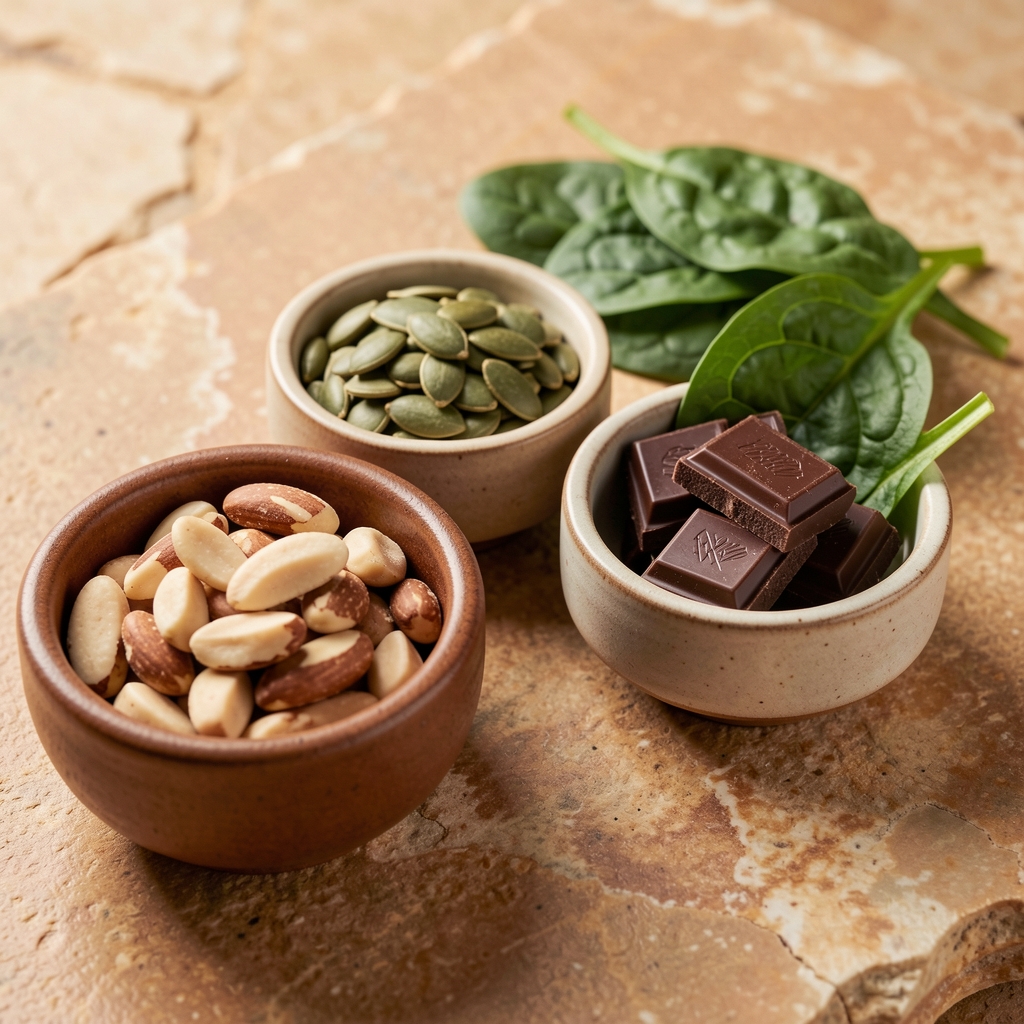
There is a quiet logic to how a body uses minerals across a day — a logic that nutritional research has been mapping with increasing precision over the past two decades. For men engaged in active daily living, the morning represents something particular: a metabolic window in which certain minerals, depleted or redistributed during sleep, are most efficiently replenished. This piece traces that logic across three minerals that appear with notable consistency in the nutritional literature on men's daily practice.
The Morning Window
The idea of a "morning window" for mineral intake has roots in the observation that certain cellular processes most active during sleep — tissue repair, immune activity, overnight metabolic work — have measurable impacts on circulating mineral levels by morning. Zinc and magnesium, in particular, show consistent morning depletion patterns in men who engage in regular physical activity, with the magnitude of depletion correlating with the intensity of the previous day's exertion.
This is not to suggest that mineral replenishment is exclusively a morning matter. The body distributes mineral intake throughout the day based on a complex set of competing absorption priorities. What the morning timing offers is a practical alignment between a man's routine — waking, eating, beginning the day's work — and the body's post-sleep state of readiness for mineral uptake. Consistency in timing, the research suggests, supports more stable mineral status over time than sporadic high-dose intake.
The three minerals examined here — zinc, magnesium, and selenium — represent different aspects of the morning routine. Zinc is the most studied in the context of active men's daily nutrition; magnesium the most broadly applicable across energy metabolism and rest quality; selenium the most specific in its cellular role. Together they form a useful mineral complex for a man building a documented supplement practice.
Zinc in Daily Practice
Zinc is involved in more than three hundred enzymatic processes in the human body. Its nutritional role spans normal cognitive function, immune health, and the maintenance of normal cell division — a breadth of involvement that partly explains why zinc deficiency is among the more common micronutrient shortfalls observed in population nutritional surveys, even in populations with apparently adequate dietary variety.
For men engaged in regular physical exertion, zinc losses through sweat represent a meaningful daily variable. Research examining sweat zinc concentration in endurance athletes has documented losses in the range of 0.5 to 1.5 mg per litre of sweat — figures that accumulate significantly over a training session or a day of active outdoor work. When dietary zinc intake is already at the lower end of the recommended range, these losses can push actual status into a range where the observed functions of zinc begin to be impaired.
Whole-food zinc sources vary considerably in their effective contribution. Oysters remain the most concentrated whole-food zinc source by weight; red meat, legumes, and pumpkin seeds contribute meaningfully at typical portion sizes. The absorptive efficiency of zinc from plant sources is generally lower than from animal sources, partly due to the presence of phytates in legumes and grains that form complexes with zinc ions in the digestive tract. This distinction matters for men whose dietary pattern skews heavily toward plant-based sources — the nominal zinc content of a meal does not translate directly to absorbed zinc.
In the supplement context, zinc bisglycinate and zinc picolinate have shown consistently higher absorption efficiency than zinc oxide in comparative research. Zinc oxide is the most common form in lower-priced multivitamin formulations, and its persistence reflects cost considerations rather than nutritional performance. For a man choosing a zinc supplement specifically to complement a whole-food diet, form matters more than many labels suggest.

[ Whole-food mineral sources — editorial reference, March 2026 ]
Magnesium and Rhythm
Magnesium's contribution to normal energy metabolism and the reduction of tiredness is well-established in the nutritional literature. What is somewhat less frequently noted in lay supplement discourse is the mineral's role in normal protein synthesis and normal muscle function — both of which are relevant to men managing an active daily schedule alongside a supplement and nutrition practice.
The rhythmic dimension of magnesium's function is interesting. Research examining magnesium status and rest quality has documented associations between lower magnesium intake and disrupted sleep architecture — specifically, a tendency toward lighter, more fragmented rest. Whether this represents a causal pathway or a correlative observation remains debated, but the consistency of the association across multiple independent studies makes it relevant to a man considering the evening component of a mineral supplement practice. Some practitioners favour magnesium intake in the evening for precisely this reason.
Magnesium glycinate and magnesium malate are the forms most commonly associated with good absorptive efficiency and low gastrointestinal response. Magnesium citrate is widely available and absorbs reasonably well, though it tends to produce noticeable changes in bowel habit at higher doses — a property some men find useful in its own right, but which can be disruptive if the primary intention is mineral replenishment rather than digestive support.
Dietary magnesium is found in dark leafy greens, legumes, whole grains, and nuts — a set of foods that appears with considerable regularity in plant-based nutrition patterns. Men whose diet already includes substantial portions of these foods may find their magnesium intake closer to adequate than they assume. Assessment via a three-day dietary record, compared against a reference intake table, is a more informative starting point than assuming deficiency.
"There is a quiet logic to how a body uses minerals across a day — a logic that nutritional research has been mapping with increasing precision."
— Eleanor Ashcroft, Tarko Journal
Selenium's Quiet Role
Selenium occupies an interesting position in the mineral complex: it is required in very small amounts, yet its functional contribution — primarily in supporting the protection of cells from oxidative stress — is significant. The enzyme families that depend on selenium as a cofactor include some of the body's most important antioxidant systems, making selenium adequacy a meaningful aspect of any nutritionally considered daily practice.
Selenium's dietary sourcing is notably geography-dependent. Soil selenium content varies dramatically by region, and crops grown in low-selenium soils reflect that deficiency in their mineral content. Brazil nuts are the most frequently cited dietary selenium source, and for good reason: two to three Brazil nuts can provide an entire day's reference intake. However, the same geographic variability applies — Brazil nuts from selenium-rich soils in the Pará region carry far more selenium than those from depleted soils elsewhere.
For supplementation, selenium methionine (selenomethionine) is the most thoroughly studied organic form, offering higher retention in body tissues than inorganic selenite. The upper tolerable intake level for selenium is lower than for most minerals — a consideration that makes it particularly important not to exceed the reference amount when supplementing, and to account for dietary selenium intake rather than viewing supplement intake in isolation.
Whole-Food vs. Supplement
The relationship between whole-food mineral sources and supplement mineral intake is complementary rather than competitive. Whole foods deliver minerals in the context of a broader nutritional matrix — with cofactors, fibre, and secondary compounds that the current research suggests contribute to absorptive efficiency and overall nutritional effect. A supplement cannot replicate that matrix; it can supplement it, in the original and precise sense of the word.
The most defensible supplement practice, from an editorial standpoint, is one that begins with a honest accounting of dietary mineral intake. Men whose routines include regular servings of the mineral-dense whole foods described above may find that targeted supplementation fills narrower gaps than they anticipated. The supplement then becomes a precision instrument rather than a dietary substitute — a distinction that shapes both the formulation choices and the quantities that make sense.
Structuring the Intake
A morning mineral practice for a man engaged in active daily living might reasonably include zinc — in bisglycinate or picolinate form — taken with a moderate meal rather than on an empty stomach. Zinc on an empty stomach is associated with nausea in a meaningful proportion of men, a response that undermines the consistency of any routine. Magnesium may be taken at any meal but tends to be better tolerated and potentially more useful when taken in the evening, particularly for men prioritising rest quality.
Selenium requires careful attention to dose. A man already consuming two to three Brazil nuts daily may have little need for selenium supplementation — and adding a standard supplement dose on top of that dietary intake moves closer to the tolerable upper level than is prudent. For men who eat few Brazil nuts and whose dietary selenium intake is uncertain, a low-dose selenomethionine supplement at or slightly below the daily reference amount is a reasonable addition.
The common thread across these three minerals is the same: the structure of a supplement practice matters more than its ambition. Consistent, modest, well-sourced mineral supplementation against a backdrop of genuine dietary attention is more valuable than a high-dose stack assembled from the most prominent supplement marketing of the season.
- → Zinc supports normal cognitive function and immune health; sweat losses during physical activity make consistent replenishment relevant for active men.
- → Magnesium contributes to normal energy metabolism and the reduction of tiredness; evening timing aligns with its association with rest quality.
- → Selenium contributes to protection of cells from oxidative stress; dose precision is particularly important given its lower upper tolerable intake level.
- → Supplement form determines absorptive efficiency: bisglycinate and picolinate (zinc), glycinate and malate (magnesium), selenomethionine (selenium) outperform cheaper alternatives.
Editorial Notice: Articles published on Tarko Journal are editorial in nature and reflect the writers' observations on everyday wellness practices. The content is not intended as professional advice, nor as guidance for the management of any specific condition. Readers with specific concerns about their daily routines are encouraged to speak with a qualified wellness professional.